


The heat in London this July has been pressing heavy on me recently. For several weeks I have had a persistent headache, sat in a dark room with the blinds drawn waiting for it to cool down in the evening enough for me to go outside comfortably.
The endlessly hot weather has thrown nature into confusion too, with blackberries ripening and sycamore trees hanging thick with seeds before August has even begun. The grass has been bone dry and yellow for months.
So with a couple of days off work I was more than happy to jump onto a train with my family and head up to Northumberland for a bit of respite.
From Kings Cross we took the train to Berwick-upon-Tweed, then a bus down to Seahouses. In the late afternoon I stepped out onto a coastline where the grass was still lush and green, the air was light and I could breathe again. As swifts, martins and swallows swirled in the cloudless sky I was so much more comfortable I almost wept.


I wasn’t there to just sit around, though. I was there to see puffins.
In the distance I could make out the shape of Inner Farne rising gently from the sea. Last August I spent a few days here but at the tail end of the breeding season I was too late for most of the puffins. This year I hoped I was on time to stroll along the boardwalks and watch the puffins scurrying to and from their burrows.
But the weather had other plans. In this summer of drought, the day I had booked for the trip was - of course - the day that clouds rolled in off the North Sea and the rain came on us in great sweeps. The island closed for visitors.
But the puffins were there: my God, the puffins were there.
We took a boat around the islands, huddled in waterproofs against the driving rain, and watched them crisscrossing the sea and jumping from the clifftops.
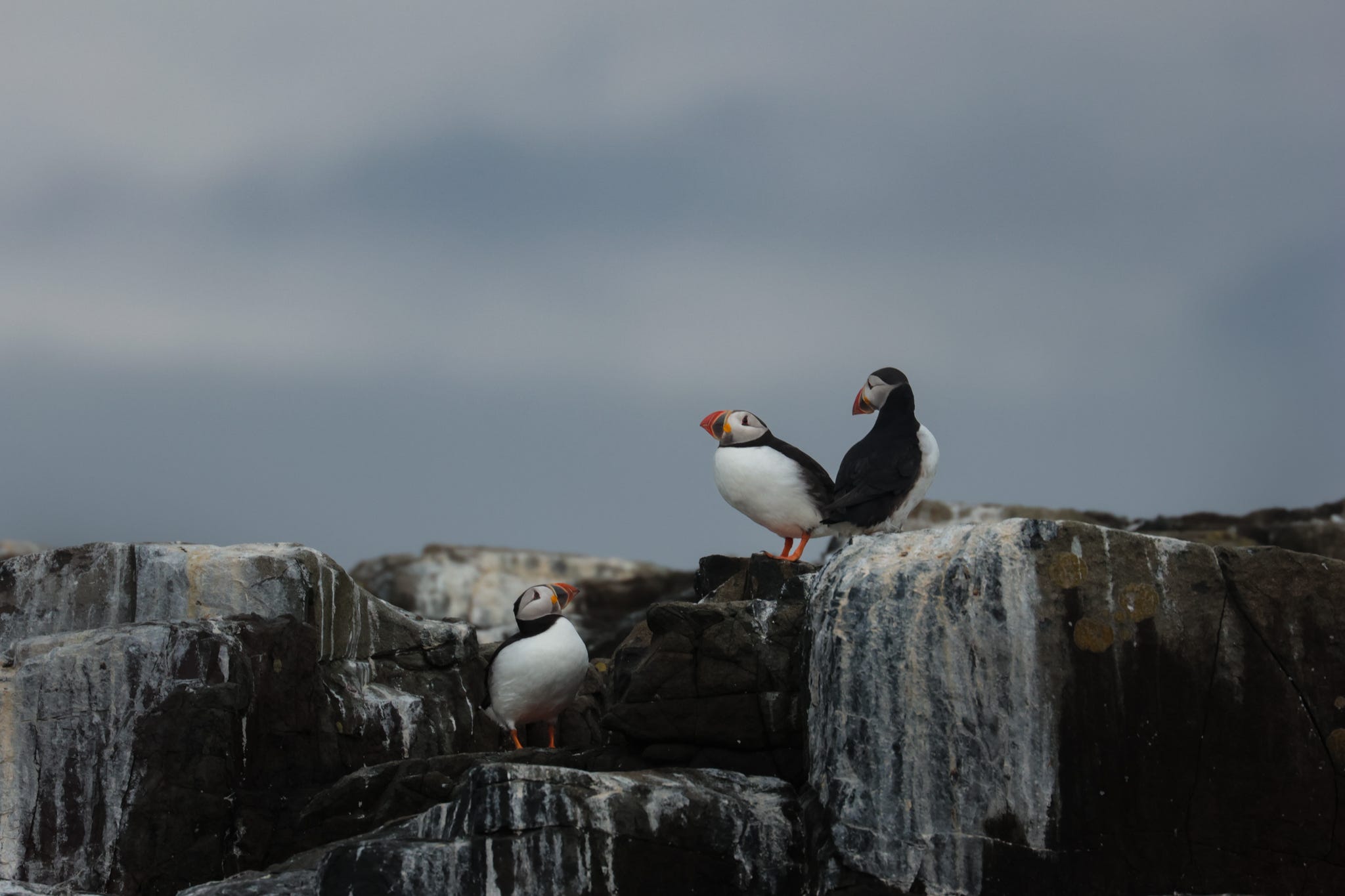


And not just puffins, but shag and guillemots and gannets and kittiwakes and eider and terns and grey seals, thronging and clamouring, a cacophony of noise amidst the spray and the salt.


The boat rolled and heaved and I kept my eyes fixed on the horizon, trying not to think about the breakfast churning in my stomach.
2025 marks the 100th year that National Trust has been caring for this rugged ocean sanctuary. Every year the puffins flock back from spending the winter rafting out at sea, and this year was no different.
But what I would give to have walked these cliffs just a few decades ago. The declines of these birds mirror the environmental crises that have unfolded worldwide over the last few decades.
John Walton, who spent 33 years working on the islands, chronicled his experiences in the June/July issue of The Northumbrian. He noted the population declines from the logbooks.
Eider: 1,800 pairs in 1983, 237 pairs in 2024.
Shag: 1,900 pairs in 1983, 61 in 2024.
Sandwich tern: 4,000 pairs in 1980, 173 in 2024.
Arctic tern: 4,500 pairs in 1983, 410 in 2024.
Common tern: 350 pairs in 1987, just 10 in 2024.
Even as the skies seemed thick with birds, and grey seals hauled themselves over the rocks, the islands were eerily quiet in comparison with years past.
The next morning, the clouds broke and a golden dawn seeped out across the harbour.
While my family slept, I sneaked out at 5 a.m. and headed onto the coastal trail that winds past the town along grassy cliffs.
I didn’t see another human soul, but the air was anything but silent. Instead, my ears filled with the sound of waves, of the cries of oystercatchers and kittiwakes.
It sounded like this:


On the way back to the house, I stopped to watch the first fishing boats arrive. One proudly waved a banner supporting Reform UK, and I wondered what kind of promises had been made to the young men working on that boat. A quick bit of searching later and I imagine they were enthusiastic about Reform’s proposals to double the size of Britain’s fishing zone.
But the party’s anti-environmental policies - to scrap net-zero and replace renewables with more North Sea drilling - would wreak havoc on the very fish that these guys rely on for their living. It doesn’t matter how big the fishing zone is, if we ramp up the boiling and polluting of our seas there won’t be any fish for them to catch.


All too soon, the return trip to London beckoned. But not before we spotted the steady rise and fall of a pod of dolphins just beyond the harbour.
They moved with such casual grace, slowly and calmly among the gentle waves. Watching dolphins at play is a privilege, and no matter what was happening that day I would have spent every minute I could with them. They made their way gradually along the coastline, towards Bamburgh, until we couldn’t see them anymore.
Beside me, my son peered out from his oversized waterproofs and watched them too. I couldn’t help but wonder what this place will be like even a few years from now.
But for now, we stood by the sea and we breathed deeply together.
Thanks for reading. If you liked this, you’ll probably like this:

Or this:

If you haven’t seen it yet, my latest film is live on YouTube:
And a personal update from me - I am, as of this week, a freelance filmmaker and photographer. My biggest challenge, I think, will be self-discipline. Advice welcome.
If you want to support my work and read my previous posts, you can become a paid subscriber to Urban Nature Diary.
Or you can buy me a coffee.
Or you can recommend me the next time you hear of someone in need of video or photography content. You can check out my work and get in touch with me here. I’m based in the UK but I work internationally.
As ever, thanks for reading.
Sounds like a great trip, it's always wonderful to spend time with puffins and other sea birds, it's so sad that their numbers are declining so much. I visited the Treshnish isles off the West coast of Scotland years ago and loved being surrounded by puffins. Sumburgh Head in Shetland is another wonderful place to see them.
Such a great trip!
Saw them in David Attenborough's Wild Isles for the first time, and I hope I'll visit them, too.